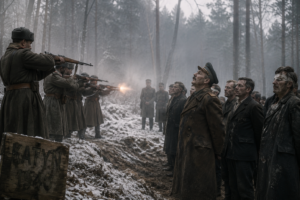
 The relationship between Russia and Poland has been marked by repeated military interventions, occupations, and political repression over more than 150 years. Below is a chronological summary of the most significant actions carried out by the Russian Empire and later the Soviet Union against the Polish state and the Polish people.
1. The Partitions of Poland (1772–1795)
In the late eighteenth century, Russia joined Prussia and Austria in the three Partitions of Poland (1772, 1793, and 1795). As a result, the Polish–Lithuanian Commonwealth disappeared from the map of Europe for more than a century.
Russia acquired the largest share of Polish territory and began a policy of integrating and Russifying the annexed lands.
2. The Kościuszko Uprising (1794)
Led by Tadeusz Kościuszko, the Polish people attempted to restore their independence.
The uprising was crushed by Russian forces. During the capture of Warsaw, Russian troops massacred an estimated 10,000–20,000 civilians in the district of Praga, one of the bloodiest episodes of the campaign.
3. The November Uprising (1830–1831)
Poles once again rebelled against Russian rule.
After suppressing the uprising, the Russian Empire:
●abolished much of Poland’s autonomy,
●dissolved the Polish army,
●executed or imprisoned many participants,
●deported thousands to Siberia, and
●intensified the policy of Russification.
4. The January Uprising (1863–1864)
Another large-scale national uprising was met with even harsher reprisals.
Russian authorities responded with:
●mass executions,
●forced labour,
●confiscation of property,
●the deportation of approximately 80,000 Poles to Siberia,
●restrictions on Polish-language education, and
●persecution of the Catholic Church.
5. The Era of Russification
Throughout the late nineteenth century, although no major war was taking place, the Russian Empire pursued systematic efforts to weaken Polish national identity.
These measures included:
●limiting the use of the Polish language,
●promoting the Russian language and Orthodox Christianity,
●restricting the influence of the Catholic Church, and
●dismantling Polish administrative institutions.
6. The Polish–Soviet War (1919–1921)
Following the First World War, the newly independent Polish Republic fought Soviet Russia.
The Soviet leadership hoped to spread the Bolshevik Revolution westward through Poland into Germany.
Poland successfully halted the Soviet advance in the Battle of Warsaw, often referred to as the “Miracle on the Vistula,” preserving its independence.
7. The Soviet Invasion of Poland (17 September 1939)
On 1 September 1939, Nazi Germany invaded Poland from the west.
Under the secret protocol of the Molotov–Ribbentrop Pact, the Soviet Union invaded Poland from the east on 17 September.
The Polish state was subsequently divided between Nazi Germany and the Soviet Union.
8. Deportations and Political Repression (1939–1941)
After occupying eastern Poland, Soviet authorities launched widespread arrests and deportations.
Between approximately 320,000 and one million Polish citizens were deported to Siberia and Central Asia, depending on the estimates used by different historians.
Those targeted included:
●military officers,
●civil servants,
●teachers,
●landowners,
●intellectuals, and
●entire families transported in cattle wagons to forced-labour settlements.
9. The Katyn Massacre (1940)
In the spring of 1940, the Soviet NKVD executed approximately 22,000 Polish prisoners.
The victims included:
●army officers,
●police officers,
●professors,
●physicians,
●clergy, and
●government officials.
Although the executions took place at several locations—including Katyn Forest, Kalinin (now Tver), and Kharkiv—the massacre became collectively known as the Katyn Massacre.
The Soviet government denied responsibility for nearly fifty years before officially acknowledging the crime in 1990.
10. Persecution of the Polish Home Army (1944–1950s)
As Soviet forces drove Nazi Germany out of Poland, they did not regard all Polish resistance fighters as allies.
Members of the Polish Home Army (Armia Krajowa), which had fought against the German occupation, were frequently:
●arrested,
●imprisoned,
●deported to the Gulag,
●executed, or
●forced into hiding.
Many continued armed resistance against the Soviet-backed communist government for years after the Second World War.
Conclusion
Russian and Soviet actions against Poland constitute a long historical pattern that included:
●the destruction of the Polish state through the Partitions of Poland,
●the violent suppression of repeated independence uprisings,
●mass executions of civilians and political opponents,
●large-scale deportations to Siberia,
●systematic Russification,
●the joint invasion and partition of Poland with Nazi Germany in 1939,
●the deportation of hundreds of thousands of Polish citizens,
●the execution of approximately 22,000 members of Poland’s military and intellectual elite in the Katyn Massacre, and
●the post-war persecution of the Polish resistance under Soviet-backed communist rule.
These events remain central to Polish historical memory and help explain why modern Poland has maintained a particularly cautious security policy toward Russia
Vastaa